Options Trading in India: A Practical Guide for Beginners (2026)
Options trading in India means buying or selling contracts on NSE or BSE that give the right to buy (a call) or sell (a put) an index or stock at a fixed strike price until expiry. Buyers pay a premium and can lose only that. Sellers collect it and must post margin. NIFTY options trade in lots of 65 and expire weekly on Tuesday.

What is options trading?
An option is a contract linked to an underlying asset (an index such as NIFTY 50 or SENSEX, or a stock). It gives the buyer the right, but not the obligation, to buy or sell the underlying at the strike price on or before the expiry. The seller (writer) receives the premium and takes on the obligation.
You don't own the shares or the index when you buy an option. You own a contract whose value depends on the underlying's price, the time left, and how volatile the market expects it to be.
Why traders use options instead of shares
- Less capital per trade. One NIFTY call lot may cost a few thousand rupees in premium, compared with the full value of the index exposure.
- Defined risk for buyers. The most you can lose on a bought option is the premium.
- Hedging. A put works like insurance on shares or a portfolio. See NIFTY hedging strategies.
- Strategies for any market view. Rising, falling, flat or volatile: there's a structure for each.
The other side of that leverage: a small move against you can wipe out a bought option entirely.
Before you start: the account you need
You need a demat and trading account with a SEBI-registered broker, with the F&O segment activated. Account opening is mostly online (PAN, Aadhaar, bank account, in-person or video verification). F&O is a separate segment: brokers usually ask for income proof and a risk disclosure before enabling it.
How to read an option chain
The option chain lists every strike for an expiry, with calls on one side, puts on the other and strikes in the middle.
| Column | What it tells you |
|---|---|
| Strike price | The price level the contract is linked to |
| LTP | Last traded price: the current premium |
| OI (open interest) | Contracts currently open at that strike |
| Change in OI | Whether positions are being added or closed today |
| Volume | How actively the strike is trading today |
| IV | Implied volatility: how much movement the market is pricing in |
| Bid / Ask | Best buy and sell prices; the gap between them is a trading cost |
How to use it before a trade:
- Find the ATM strike: the one closest to the current price.
- Pick your strike relative to it. Out-of-the-money options are cheaper but need a bigger move; in-the-money options cost more but move more like the underlying.
- Check liquidity. Good volume and OI mean a tight bid-ask spread. Illiquid strikes cost you on the way in and again on the way out.
- Check IV. High IV makes options expensive to buy and rich to sell. See the best indicators for options trading.
Calls and puts, with worked examples
| Call (CE) | Put (PE) | |
|---|---|---|
| Buy it when | You expect the price to rise | You expect the price to fall |
| Buyer's maximum loss | Premium paid | Premium paid |
| Breakeven at expiry | Strike + premium | Strike − premium |
Premium vs margin
Buying an option: you pay only the premium. No further margin. Your maximum loss is known.
Selling an option: the exchange requires margin, calculated with SPAN plus exposure margin, because a seller's loss can be far larger than the premium received. For a naked index option this commonly runs into lakhs of rupees per lot and changes with volatility. Hedged positions (spreads) need less. Your broker shows the exact margin before you confirm a sell order: check it every time.
This is why most beginners start by buying options or with hedged spreads. Read the option selling guide before writing options.
Lot sizes and expiry days in 2026
- 65 NIFTY lot size (was 75)
- 30 BANK NIFTY lot size (was 35)
- Tuesday NIFTY weekly and NSE monthly expiry day
NSE revised index lot sizes from the January 2026 contract series. Any calculator, spreadsheet or old article multiplying by 75 or 35 will give the wrong numbers. Lot sizes are reviewed periodically, so confirm the current figure on NSE before sizing a trade. If you run automated strategies, see our lot-size checklist.
Since November 2024 each exchange offers one weekly index expiry: NIFTY 50 on NSE and SENSEX on BSE. BANK NIFTY, FINNIFTY and MIDCPNIFTY now have monthly expiries only. NSE expiries fall on Tuesday; BSE's on Thursday.
| Weekly options | Monthly options | |
|---|---|---|
| Available on | NIFTY (NSE), SENSEX (BSE) | All index and stock options |
| Premium swings | Sharp, fast | Smoother |
| Time decay | Fast, especially in the last two days | More gradual |
| Suits | Traders watching positions through the day | Positional trades over several sessions |
Theta decay: the cost beginners ignore
Theta is the daily fall in an option's time value. It happens even when the underlying doesn't move, and it speeds up near expiry.
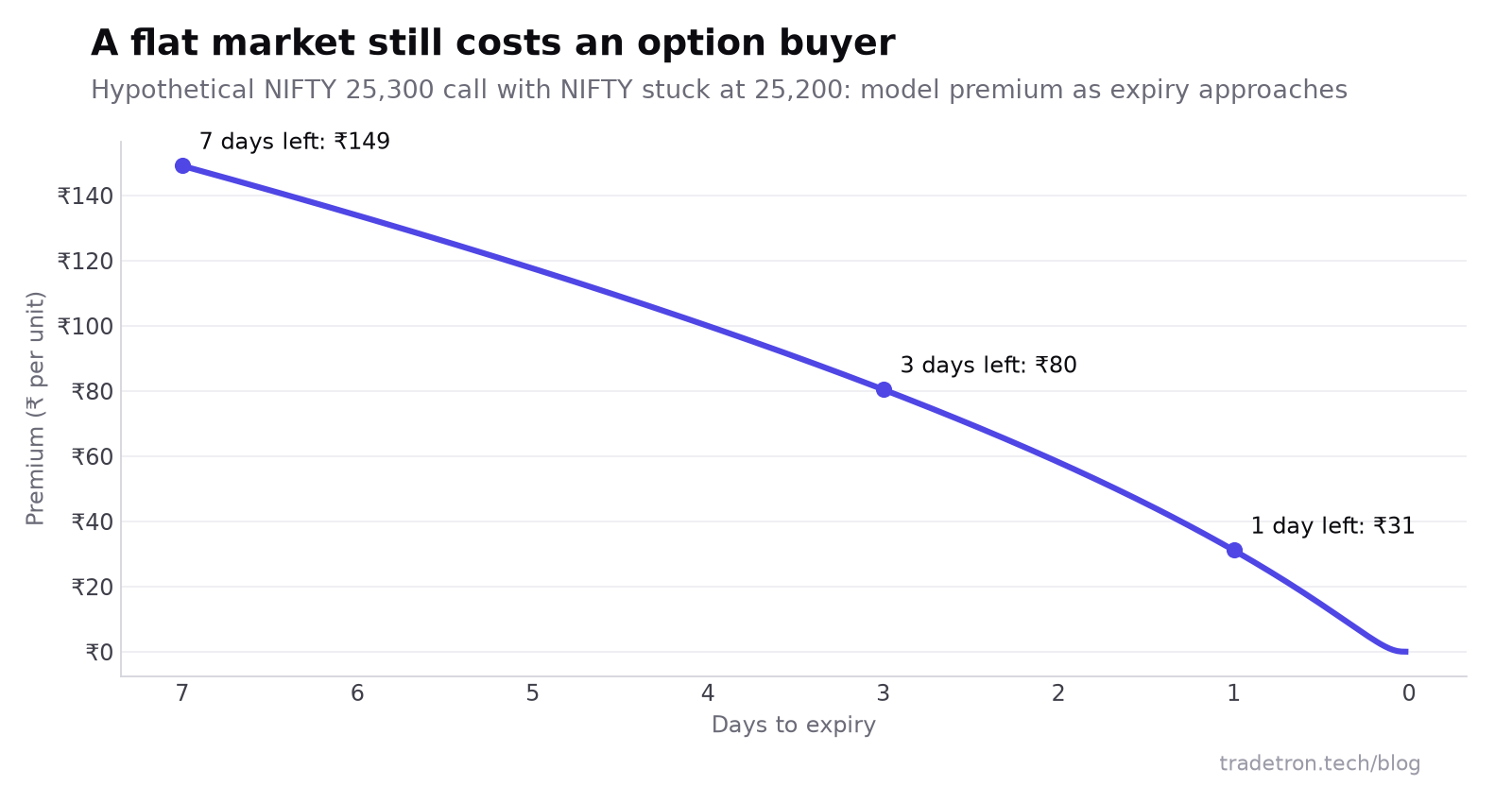 With the market flat, the same call loses most of its value in the final week (model prices)
That's why "wait and see" is a weak plan for an option buyer. Every day of waiting costs money. The other Greeks matter too:
- Delta: how much the premium moves for a ₹1 move in the underlying. An ATM option is near 0.5.
- Gamma: how fast delta changes. High near expiry, which is why premiums can jump sharply.
- Vega: sensitivity to implied volatility. When IV jumps around an event, vega moves the premium even if the price barely changes.
For how premium is built up from these factors, see how to calculate option premium.
A complete NIFTY trade, start to finish
NIFTY is at 25,150. You buy the 25,200 call at ₹85 (example premium). One lot costs ₹85 × 65 = ₹5,525.
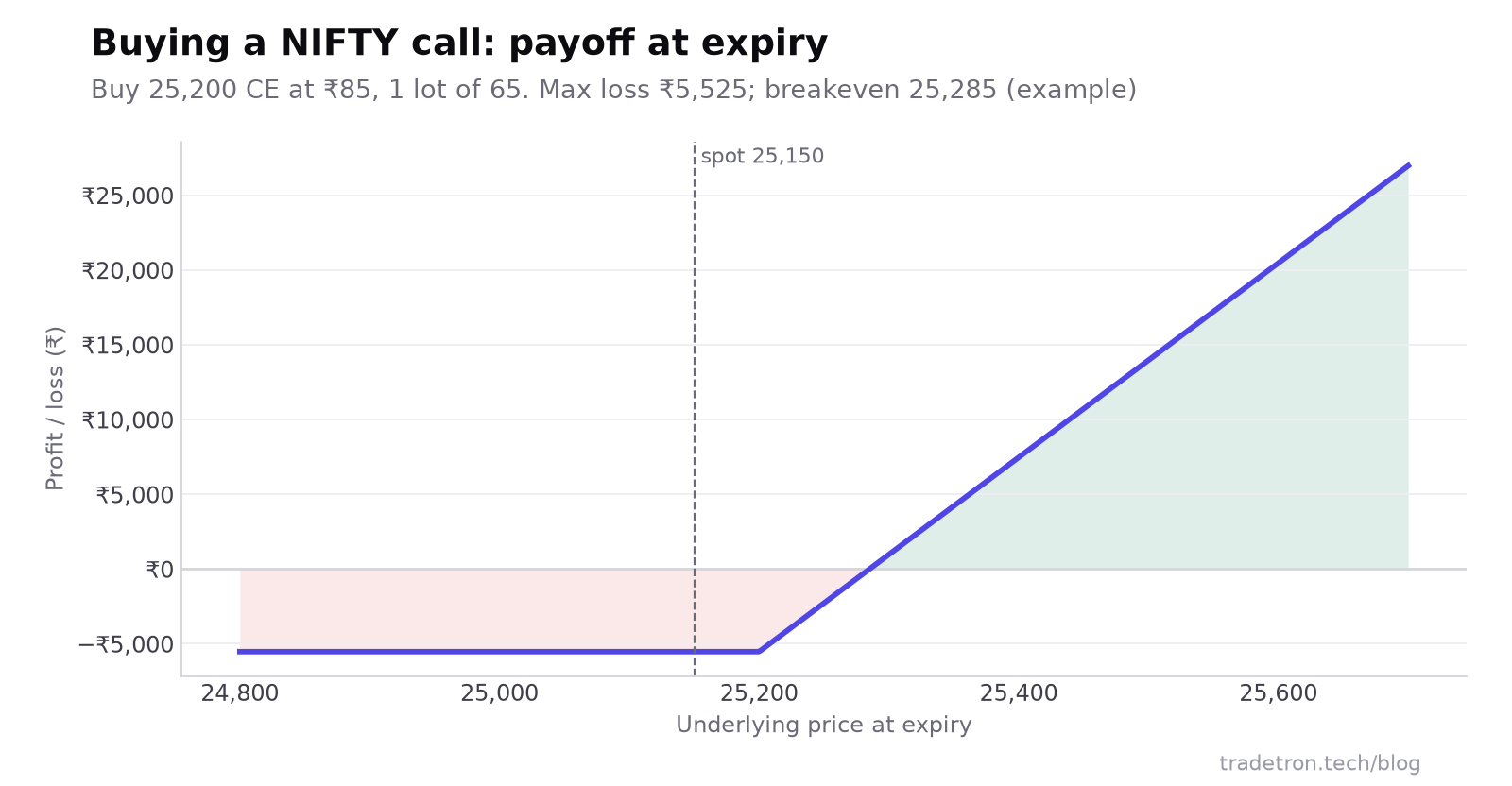 A bought call: losses are capped at the premium; profit starts above strike + premium
- The trade works: the premium rises to ₹130. Profit = (130 − 85) × 65 = ₹2,925, about 53% of the money you put in.
- The trade fails: the premium falls to ₹45 and you exit. Loss = (85 − 45) × 65 = ₹2,600, about 47%.
Gains and losses are both large relative to the premium you paid. That is why position size and a stop matter more here than with shares.
What can ₹10,000 realistically do?
Can ₹10,000 turn into a lakh on one lucky trade? Mathematically, occasionally. As a plan, no. With small capital, the realistic goal is to learn clean execution: enter with a written plan, exit at a pre-decided stop, and never average into a losing option. Test your rules on historical data and in a simulated mode first, so early mistakes cost nothing.
Hidden costs: spreads, charges and expiry settlement
- Bid-ask spread. If buyers bid ₹50 and sellers ask ₹55, crossing that gap costs ₹5 per unit (₹325 on a NIFTY lot) before the market moves. Stick to liquid strikes.
- Charges. Brokerage, STT, exchange fees, GST and stamp duty apply to every trade. On small premiums and frequent trades, they add up.
- Expiry settlement. Index options are cash-settled. Stock options are physically settled, so an in-the-money stock option held to expiry can mean delivering or taking delivery of shares, with the margin that requires. Close or roll positions you don't intend to settle before expiry day's close, and check how STT applies to exercised contracts.
Why most beginners lose money
SEBI's study of individual traders in equity derivatives for FY25 found that about 9 in 10 lost money, with combined net losses of roughly ₹1.06 lakh crore.
Common mistakes to avoid:
- Entering without a stop-loss
- Averaging down on a losing option
- Over-trading to recover a loss
- Buying far OTM options on expiry day
- Ignoring liquidity, IV and theta
Four options strategies for beginners
| Strategy | When to use it | Maximum loss | Main risk |
|---|---|---|---|
| Buying calls | You expect a rise | Premium paid | Theta decay every day |
| Buying puts | You expect a fall | Premium paid | A fall in IV can shrink the premium |
| Covered calls | You hold the shares and expect little movement | The shares' downside, cushioned by the premium | Upside capped at the strike |
| Long straddle or strangle | You expect a big move, direction unknown | Both premiums | Both legs decay if nothing happens |
More: options trading for beginners on Tradetron, long straddle, strangle and iron condor.
Risk management: the skill that matters
Manual vs automated options trading
| Manual | Automated | |
|---|---|---|
| Execution | Depends on your reaction time | Immediate when rules are met |
| Emotion | High under pressure | Rules don't hesitate |
| Monitoring | Constant screen time | Rules watch the market |
| Consistency | Varies day to day | Same rules every time |
Most people can't watch a screen all session. Missed entries, late exits and panic decisions are what automation removes. It doesn't fix a losing strategy: a rule set that loses money manually loses money automatically too.
Frequently asked questions
How do I start options trading in India?
Open a demat and trading account with a SEBI-registered broker, activate the F&O segment, learn to read the option chain, and start with small, defined-risk trades such as buying a single lot with a pre-set stop. Test your rules on historical data or in a simulated mode first.
What is the minimum amount needed to trade options in India?
To buy an option, you need the premium × lot size: a NIFTY option at ₹80 costs ₹5,200 for one lot of 65. Selling options needs margin, which is much higher. The useful number is how much you can afford to lose on one trade.
What is the lot size of NIFTY and BANK NIFTY options?
From the January 2026 series, NIFTY's lot size is 65 and BANK NIFTY's is 30, down from 75 and 35. NSE reviews lot sizes periodically, so check the current figure before trading.
Which day do NIFTY options expire?
NIFTY weekly and monthly options expire on Tuesday. BANK NIFTY, FINNIFTY and MIDCPNIFTY have only monthly expiries. On BSE, SENSEX weekly options expire on Thursday.
What is the difference between premium and margin?
Premium is the price of the option: the buyer pays it and it's the buyer's maximum loss. Margin is the deposit a seller must keep with the broker, because the seller's potential loss is not capped at the premium.
What are the trading hours for options in India?
Equity and index options on NSE and BSE trade from 9:15 am to 3:30 pm on trading days, after a pre-open session for the cash market.
How are options profits taxed in India?
For most active traders, F&O profits are treated as business income rather than capital gains. Your exact treatment depends on your overall trading activity and turnover, so confirm with a chartered accountant.