Options Expiry Day Traps: 7 Mistakes to Avoid

On options expiry day, contracts settle and every bit of time value disappears by the close. That makes premiums swing far more for each point the index moves, and turns small mistakes into big ones. The common traps are buying cheap out-of-the-money options as lottery tickets, holding naked short options into the final hour, forgetting how settlement works, and making unplanned last-minute trades.
How options expiry works in India
| Index options | Stock options | |
|---|---|---|
| Examples | NIFTY 50, BANK NIFTY, SENSEX | Individual F&O stocks |
| Weekly expiry | NIFTY (NSE, Tuesday), SENSEX (BSE, Thursday) | No |
| Monthly expiry | Yes; NSE contracts expire on Tuesday | Yes |
| Settlement | Cash: only the difference is paid | Physical: shares are delivered |
| Style | European: exercised only at expiry | European |
Since late 2024 each exchange has had one weekly index expiry: NIFTY on NSE and SENSEX on BSE. BANK NIFTY, FINNIFTY and MIDCPNIFTY expire monthly. Older articles that describe expiries for every index every week, or Thursday expiries on NSE, are out of date.
At expiry, an in-the-money option is settled at its intrinsic value; an out-of-the-money option expires worthless. All time value is gone.
Why expiry day moves so fast
Early in an option's life, a 100-point move in NIFTY changes the premium modestly, because a lot of the price is time value. In the last hour there's almost no time value left, so the price snaps towards its value at expiry: zero below the strike, intrinsic value above it.
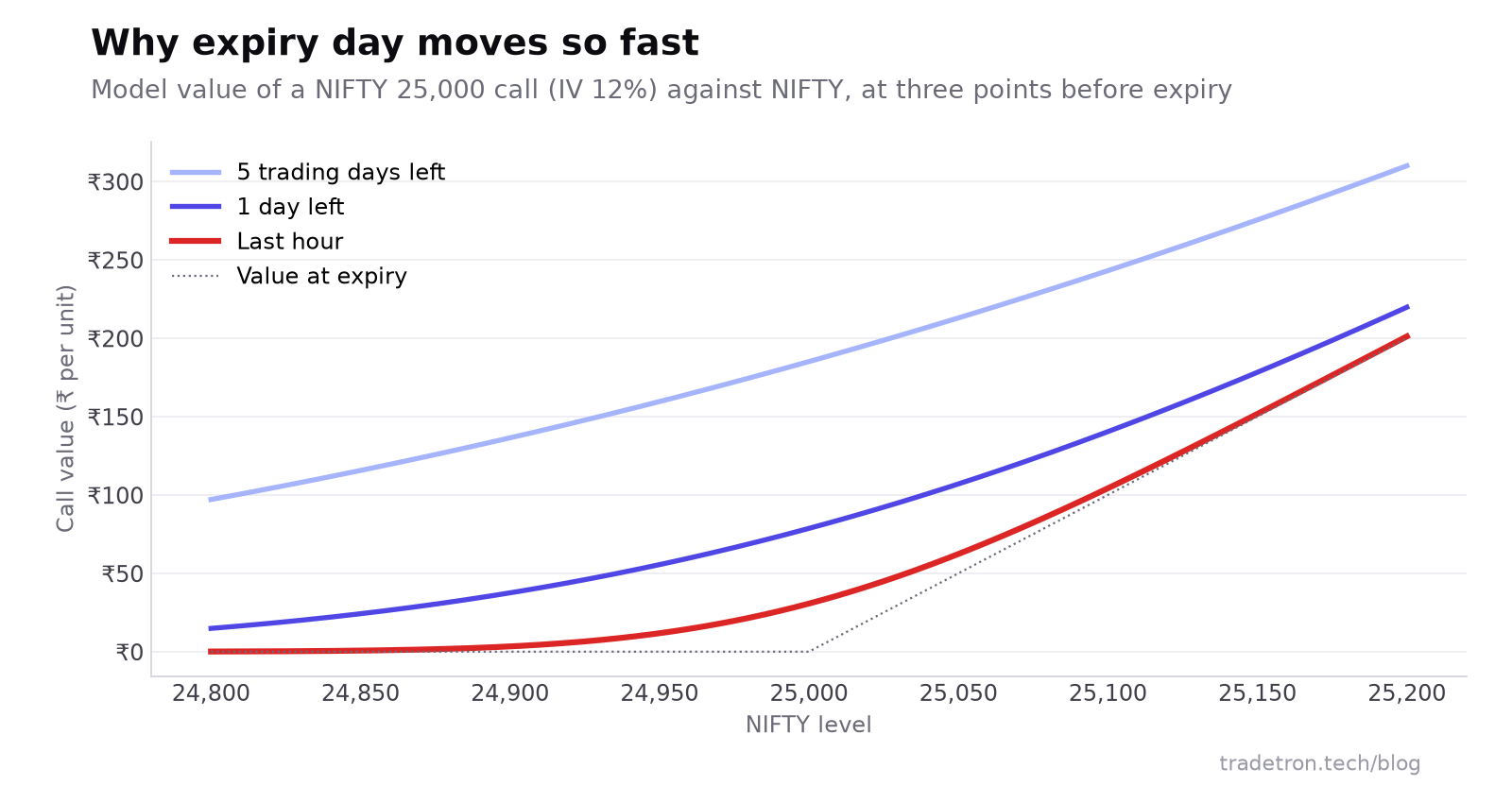 As expiry approaches, the option's value bends sharply around the strike (model prices)
- ₹160 → ₹213 NIFTY 24,950 → 25,050 with 5 days left (+33%)
- ₹12 → ₹62 the same 100-point move in the last hour (about 5×)
This sensitivity is gamma. It's what makes expiry-day option buying feel like a lottery and expiry-day option selling feel like picking up coins in front of a train.
Trap 1: Buying cheap out-of-the-money options as lottery tickets
A far out-of-the-money option on expiry morning can cost ₹2–5. It looks like a small bet with a big upside. But it's cheap because the market gives it a low chance of ending in the money. Most expire worthless, and buying them every week adds up to a steady loss.
Instead: if you buy options on expiry day, size the trade as if the premium will go to zero, and have a written reason for expecting a move larger than the market is pricing.
Trap 2: Holding naked short options into the final hour
Option sellers love expiry day because time decay is fastest. The same gamma that melts premiums can make a ₹10 short option worth ₹100 within an hour if NIFTY moves to the strike. A naked short position has no ceiling on that.
Instead: close or hedge short options before the final hour, buy wings so the loss is capped (see iron condor), and set a strategy-level loss limit.
Trap 3: Forgetting how settlement works
- Stock options are physically settled. An in-the-money stock option open at expiry means delivering or receiving the shares, which needs money or shares in your account. Brokers often ask for higher margin or close such positions in the days before expiry.
- Exercised options attract STT on settlement, calculated differently from STT on a normal sale. Check how your broker applies it before letting an in-the-money option expire instead of squaring it off.
- Index options are cash-settled, but an in-the-money option you forgot about still settles: make sure that's what you intended.
Instead: close or roll positions you don't want settled before the close on expiry day.
Trap 4: The last-minute rush
As the close approaches, traders make impulsive decisions to "save" a losing trade or chase a final move. Spreads can widen in the final minutes, especially in strikes away from the money, so orders fill at worse prices than expected.
Instead: set expiry-day exit times in advance (for example, all positions closed by 3:15), and don't open new positions in the last half hour unless that's your tested strategy.
Trap 5: No loss limit for the day
Expiry-day swings mean a day's loss can be several times a normal day's. Without a maximum loss per day, one bad expiry can undo weeks of results.
Instead: set a rupee loss limit for the strategy and the day, sized so the worst case is survivable. See seven ways to reduce drawdown.
Trap 6: Ignoring market conditions and events
News during expiry day, a large global move overnight, or an index heavyweight's results can push the index through a strike in minutes. A plan made for a quiet day doesn't survive a volatile one.
Instead: check the calendar before expiry day; reduce size or stand aside on event days; and use volatility filters such as India VIX or an ATM IV level to switch a strategy off when the market is unusually jumpy.
Trap 7: Using stale rules
Strategies built for older market rules can misfire: Thursday expiries on NSE, weekly BANK NIFTY options, or the old lot sizes. A strategy that hard-codes an expiry weekday or a lot size may enter on the wrong day or with the wrong quantity. Our lot-size checklist covers what to review.
An expiry-day checklist
- Know which contracts expire today: NIFTY on Tuesday (NSE), SENSEX on Thursday (BSE), monthlies on the last expiry of the month.
- List every open position expiring today and decide: close, roll or let it settle.
- Cap the day's loss in rupees before the market opens.
- Hedge or close naked short options before the final hour.
- Set a hard exit time and stick to it.
- No unplanned trades in the last 30 minutes.
Frequently asked questions
What happens to options on expiry day?
At the close, in-the-money options are settled at their intrinsic value and out-of-the-money options expire worthless. Index options are cash-settled; stock options are physically settled with delivery of shares.
Which day do NIFTY options expire?
NIFTY weekly and monthly options expire on Tuesday. SENSEX weekly options expire on Thursday on BSE. BANK NIFTY, FINNIFTY and MIDCPNIFTY have monthly expiries only.
Why do option prices move so much on expiry day?
Because almost no time value is left, the option's price tracks its value at expiry very closely, which changes sharply around the strike. This high gamma means a small index move can multiply or wipe out a near-the-money option's price.
Is it a good idea to buy cheap options on expiry day?
Usually not as a habit. Far out-of-the-money options are cheap because they rarely end in the money, and most expire worthless. If you buy them, size the trade so losing the whole premium is acceptable.
Should I hold an in-the-money option until expiry?
For index options, it will be cash-settled, but check how STT applies to exercised contracts compared with selling before the close. For stock options, holding in the money to expiry means physical delivery of shares, so close or roll unless you intend to settle.
Can I automate expiry-day exits?
Yes. On Tradetron you can set time-based exits, daily loss limits and hedge legs as rules, so they run on every expiry day without manual action.