Butterfly Strategy in Options: Complete Guide for Indian Traders

The butterfly strategy in options is a three-strike spread that profits if the underlying finishes near a chosen middle strike at expiry. A long call butterfly buys one lower-strike call, sells two middle-strike calls and buys one higher-strike call, all with equal spacing and the same expiry. Both the maximum loss (the small net premium paid) and the maximum profit are known when you enter.
How a butterfly spread works
A long call butterfly is two vertical spreads that share a middle strike:
- A bull call spread: buy the lower call, sell one middle call.
- A bear call spread: sell the other middle call, buy the upper call.
The two sold options in the middle pay for most of the two bought options at the edges, so the position costs little. If the underlying sits exactly on the middle strike at expiry, the lower call is worth the full strike spacing and everything else expires worthless: maximum profit. Anywhere outside the outer strikes, all the options cancel out and you lose only the small debit.
Premiums here are example figures, priced with a standard option model for illustration. They are not live prices.
Butterfly payoff, max profit, max loss and breakevens
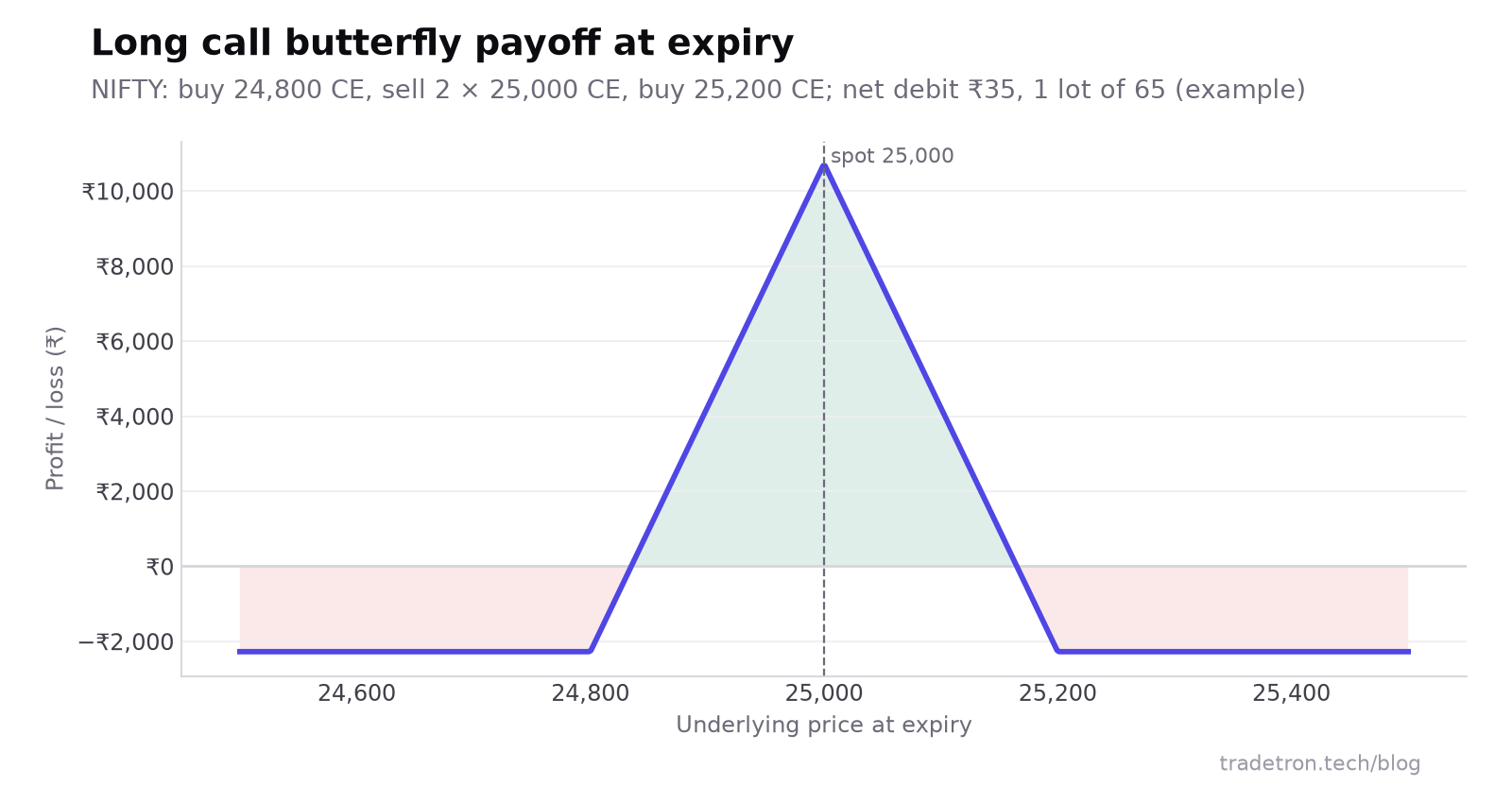 A long call butterfly: small fixed loss on both sides, a sharp peak at the middle strike
| Formula | Example | |
|---|---|---|
| Net debit (max loss) | Lower + upper premium − 2 × middle premium | ₹35 × 65 = ₹2,275 |
| Maximum profit | Strike spacing − net debit | (200 − 35) × 65 = ₹10,725 |
| Lower breakeven | Lower strike + net debit | 24,800 + 35 = 24,835 |
| Upper breakeven | Upper strike − net debit | 25,200 − 35 = 25,165 |
| Profit zone width | Upper breakeven − lower breakeven | 330 points |
In practice, few butterflies are held to the exact peak. Traders usually take profits when the position has gained a set share of its maximum, because the last few points of profit need the price to sit almost exactly on the middle strike at the close.
Types of butterfly strategies
| Variant | Legs | Cost | Notes |
|---|---|---|---|
| Long call butterfly | Buy 1 lower CE, sell 2 middle CE, buy 1 upper CE | Debit | The classic version |
| Long put butterfly | Buy 1 upper PE, sell 2 middle PE, buy 1 lower PE | Debit | Same payoff shape, built with puts |
| Iron butterfly | Sell ATM CE + ATM PE, buy OTM CE + OTM PE | Credit | A short straddle with wings; max profit is the credit |
| Broken-wing butterfly | Uneven spacing, e.g. 200 points below, 300 above | Small debit or credit | Removes risk on one side, adds it on the other |
| Short butterfly | The long butterfly reversed | Credit | Profits from a move away from the middle strike |
The iron butterfly is the version most often traded on NIFTY by option sellers. It collects a credit instead of paying a debit, and its payoff is the same tent shape. Our short straddle guide shows how adding wings to a straddle creates one.
Long put butterfly
Buy one higher-strike put, sell two middle-strike puts and buy one lower-strike put. With the same strikes and expiry, the payoff at expiry is essentially the same as the call version. Traders choose between them based on which options are more liquid or better priced.
When traders use a butterfly
- You expect the price to settle near a level. For example, a strike with very large open interest that the market has been gravitating to, or a quiet pre-expiry session.
- Close to expiry. Butterflies gain value fastest in the last days, as time decay hits the two sold options. Far from expiry the position moves slowly.
- Low cost is the priority. The maximum loss is small and known, which suits traders who want a defined risk.
- High implied volatility, for the iron version. Iron butterflies collect more credit when IV is high.
Butterfly vs iron condor
| Butterfly | Iron condor | |
|---|---|---|
| Profit zone | Narrow, peaked | Wide, flat |
| Chance of profit | Lower | Higher |
| Reward relative to risk | High | Lower |
| Best when | You expect a specific level | You expect a range |
If you expect a range rather than a precise level, an iron condor gives a wider profit zone in exchange for a lower reward-to-risk ratio.
Risks and practical points
- Narrow target. Most of the time the price won't finish near the middle strike. Expect frequent small losses or partial profits.
- Execution across four legs. Placing legs one by one in a fast market can change the net cost. Use liquid strikes close to the money.
- Early in the trade, little happens. A week or more from expiry, the position's value barely changes even if the price sits on the middle strike.
- Costs matter. With four option legs, brokerage, taxes and slippage are a larger share of a small debit. Include them when you test.
- Holding into expiry. If the price is between strikes at the close, legs settle at different values. Many traders close the whole position before the final minutes.
Example: a butterfly around a high open-interest strike
- Find the level. On Monday, NIFTY is close to a strike with large open interest on both calls and puts.
- Choose the wings. 200 points either side of that strike, same weekly expiry.
- Check the cost. If the net debit is small compared with the 200-point spacing, the reward-to-risk is favourable.
- Set exits. Take profit at a set share of the maximum, and close everything before the final minutes on Tuesday.
- Accept the loss if it moves away. The debit is the stop: no adjustment needed.
This is an illustration of how traders reason about the trade, not a recommendation. Test the rules on past data before using them.
Frequently asked questions
What is the butterfly strategy in options?
It is a three-strike options spread: buy one lower-strike option, sell two middle-strike options and buy one higher-strike option, with equal spacing and the same expiry. It profits most if the underlying finishes at the middle strike.
What is the maximum profit and loss of a butterfly spread?
For a long butterfly, the maximum loss is the net debit paid and the maximum profit is the strike spacing minus that debit. In the NIFTY example, that is ₹2,275 maximum loss and ₹10,725 maximum profit per lot.
How do you calculate the breakevens of a butterfly?
Add the net debit to the lower strike for the lower breakeven, and subtract it from the upper strike for the upper breakeven.
What is the difference between a butterfly and an iron butterfly?
A long call or put butterfly uses only calls or only puts and costs a net debit. An iron butterfly sells an at-the-money call and put and buys out-of-the-money wings, collecting a net credit. Both have a peaked payoff with capped risk.
When should you use a butterfly strategy?
When you expect the underlying to finish close to a specific price at expiry, usually in the last few days before expiry, and want a small, defined maximum loss.
Is the butterfly strategy low risk?
Its maximum loss is small and known if all legs are held together, so the risk is defined. But the chance of reaching the maximum profit is low, and costs across four legs are significant compared with the small debit.