Algorithmic Options Trading Software: A Complete Guide
Algorithmic options trading software turns an options strategy into written rules (when to enter, which strikes to trade, where to exit) and then places and manages the orders for you through your broker. Good software also lets you backtest those rules on historical data and run them in a test mode before any real order is sent.

What is algorithmic options trading?
Algorithmic options trading means a computer program places options trades when conditions you defined are met. The conditions can be based on:
- Time: enter at 9:30, exit at 3:15.
- Price: NIFTY breaks above the day's opening range.
- Indicators: RSI, moving averages, Supertrend, VWAP.
- Options data: implied volatility, open interest, put-call ratio, premium levels.
- Risk: the strategy's loss reaches a fixed amount, or a leg's premium doubles.
Options are a natural fit for automation because a single strategy often has several legs, each with its own stop and target, and timing matters to the minute, especially close to expiry.
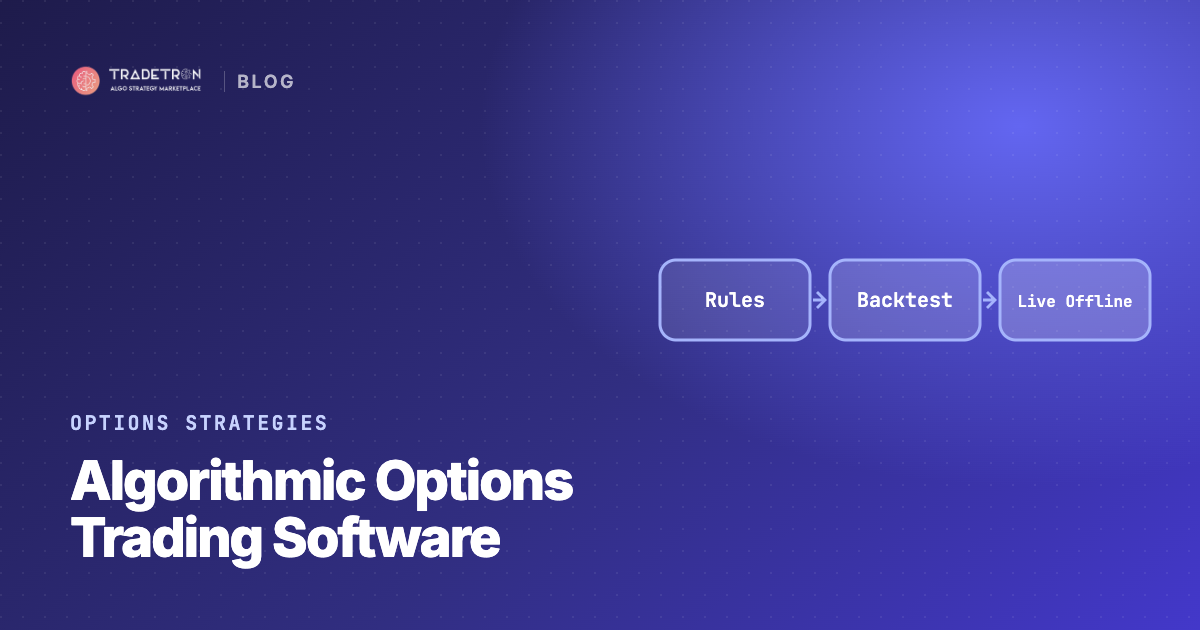
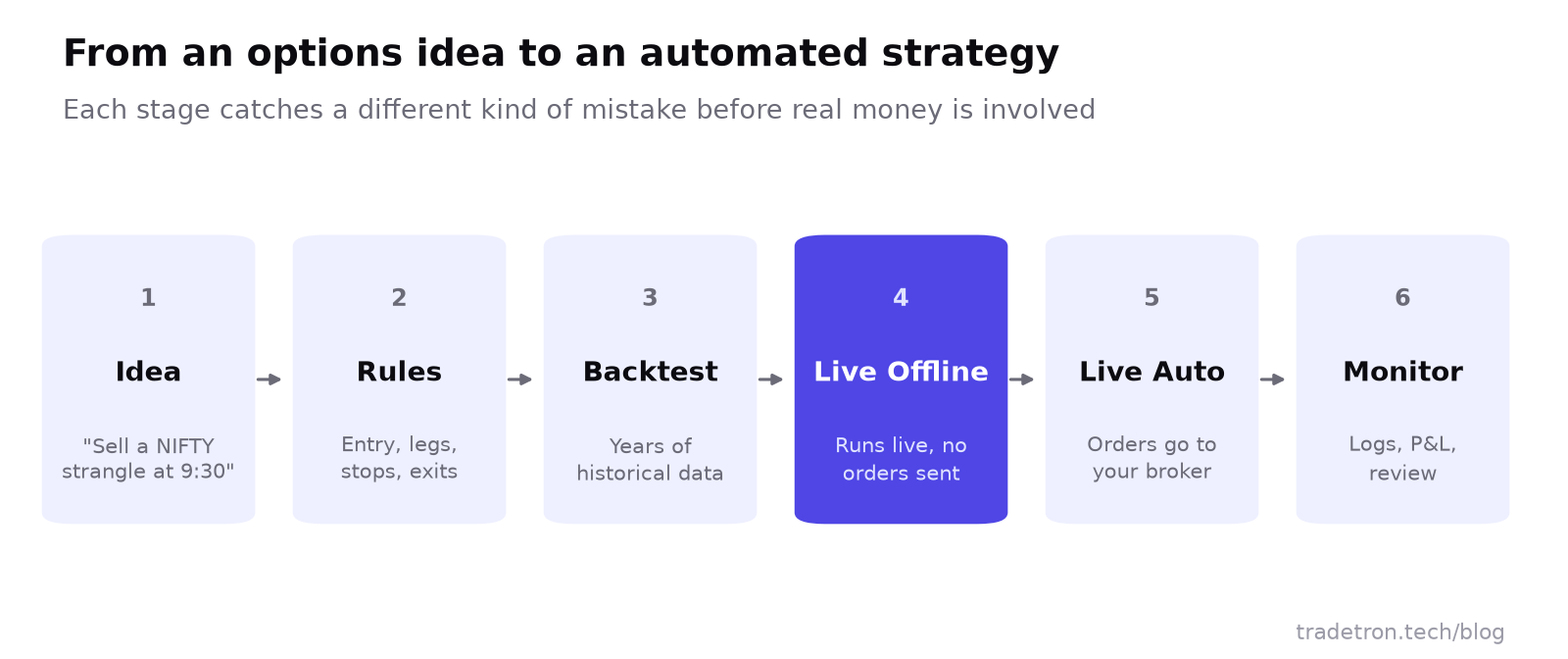 How a rule-based options strategy moves from idea to live trading
What the software actually automates
| Task | Done manually | Done by the algo |
|---|---|---|
| Watching for the entry | You watch the screen | Checked on every price update |
| Picking strikes | Read the option chain, calculate | Rule such as ATM, ATM ± n strikes, premium near ₹100, or delta 0.2 |
| Placing multi-leg orders | One leg at a time | All legs placed by the same rule |
| Stop-loss per leg | Watch each leg, react | Exits when the leg's SL trigger is hit |
| Adjustments and re-entries | Judgement under pressure | Pre-written repair rules |
| End-of-day square-off | Remember to do it | Time-based exit |
| Running several strategies | Hard to track | Each runs independently |
Features to check before you choose software
- Strike and expiry selection. Can you choose strikes relative to ATM, by premium, or by delta? Can you pick weekly or monthly expiry, and roll to the next one?
- Per-leg and strategy-level risk controls. Each leg should take its own stop and target, and the whole strategy should take a loss limit, a profit lock or trailing stop, and a time exit.
- Backtesting on options data. The backtest should use historical option prices, not just the index, and show trade-by-trade results, drawdowns and the worst day. Check that it uses the lot sizes in force at the time.
- A real test mode. Before going live you want the strategy running on today's prices with every trade recorded, but no orders sent. On Tradetron this is Live Offline.
- Broker connections. The software should connect to the broker you already use, and handle order placement through it.
- Logs and alerts. When something goes wrong (an order rejected, a margin shortfall), you need to know what happened and when.
- A path for ideas from elsewhere. If you already use TradingView or Amibroker signals, check whether they can trigger the strategy.
Options strategies that suit automation
| Strategy | Why automation helps | Read more |
|---|---|---|
| Short straddle / strangle | Many legs, tight per-leg stops, fixed entry and exit times | Short straddle, strangle |
| Iron condor and credit spreads | Four legs, defined risk, rule-based adjustments | Iron condor |
| Directional option buying | Indicator-based entries need fast, consistent execution | Indicators for options |
| Hedged positions | Hedges must be placed with the main leg, every time | NIFTY hedging |
| Butterflies and ratio spreads | Exact strike spacing and quantities | Butterfly strategy |
Manual vs algorithmic options trading
| Manual | Algorithmic | |
|---|---|---|
| Execution speed | Depends on you | Immediate when conditions are met |
| Consistency | Varies with mood and attention | Same rules every time |
| Monitoring | Needs constant attention | Rules monitor the market for you |
| Multiple strategies | Hard to manage | Each runs on its own |
| Flexibility | Can react to news | Only does what the rules say |
| Testing | Hard to verify past results | Can be backtested and run in test mode |
Manual trading still has one advantage: judgement about things your rules don't cover. Good automation leaves room for that by letting you pause or exit a strategy at any time.
The risks automation doesn't remove
- Strategy risk. A rule that loses money manually loses money automatically, just faster.
- Overfitting. Tuning rules until the backtest looks perfect usually produces a strategy that fails on new data. Keep rules simple and test across different market phases.
- Gap and liquidity risk. Stops execute at the next available price. Far out-of-the-money strikes and fast markets can mean slippage.
- Technology and connectivity. Broker outages, expired sessions and margin shortfalls can stop orders going through. Check logs daily.
- Backtest-to-live gaps. Slippage, costs and timing make live results differ from backtests. See nine reasons your backtest doesn't match live trading.
Is algorithmic options trading allowed in India?
Yes. Retail traders can run algorithmic strategies through SEBI-registered brokers. SEBI's framework for retail algo trading requires algos to be routed through brokers and identified with an algo ID. The details of what traders need to do are in our article on SEBI's algo-ID mandate, and the broader question is covered in is algo trading legal in India.
Who should use algorithmic options trading software?
- Active options traders who already follow fixed rules and want them executed without missing entries or stops.
- Traders with a day job who can't watch the market all session.
- Strategy creators who want to test many variations of an idea quickly.
- Beginners, with care: start with defined-risk strategies, small size and plenty of test-mode time.
Frequently asked questions
What is algorithmic options trading software?
It is software that executes options trades automatically from rules you define: when to enter, which strikes and expiry to trade, how much, and when to exit. Most platforms also offer backtesting and a test mode.
Do I need to know coding to trade options algorithmically?
No. No-code platforms such as Tradetron let you build strategies by choosing conditions, keywords and legs in a visual builder. Coding helps for unusual logic but isn't required.
Is algorithmic options trading legal in India?
Yes. Retail algo trading is allowed through SEBI-registered brokers, under SEBI's framework that requires algos to be identified and routed through brokers.
Which options strategies are best for automation?
Strategies with several legs and strict rules benefit most: short straddles and strangles with per-leg stops, iron condors, credit spreads, hedged positions and indicator-based option buying.
Does algorithmic trading software make a strategy profitable?
No. Software only executes your rules. Whether a strategy makes or loses money depends on the strategy itself and the market. Test it on historical data and in a test mode, and size positions so a losing period is survivable.
How do I test an options algo before using real money?
Backtest it on historical data across calm and volatile periods, then run it in a test mode on live prices. On Tradetron, Live Offline runs the strategy and records every trade without sending orders to the exchange.