Types of Crypto Trading: Which One Suits Your Strategy?
The main types of crypto trading are spot trading, margin trading, futures and perpetuals, options, arbitrage, day trading and scalping, and algorithmic trading. They differ in whether you own the coin, whether you use leverage, how long you hold, and how much time and speed they demand. Which one suits you depends on your experience, your risk tolerance and how much attention you can give the market.
Crypto trading types at a glance
| Type | Own the coin? | Leverage | Typical holding time | Main risk | Suits |
|---|---|---|---|---|---|
| Spot | Yes | No | Days to years | Price falls | Beginners, long-term holders |
| Margin | Yes, with borrowed funds | Yes | Hours to weeks | Losses beyond your margin, interest | Experienced traders |
| Futures and perpetuals | No | Yes | Minutes to weeks | Liquidation, funding costs | Active traders, hedgers |
| Options | No | Built in | Hours to weeks | Losing the premium, or large losses when selling | Traders who understand options |
| Arbitrage | Briefly | Sometimes | Seconds | Fees, delays, gaps closing | Traders with fast execution |
| Day trading and scalping | Varies | Often | Seconds to hours | Costs, overtrading | Full-time, disciplined traders |
| Algo trading | Depends on the style | Depends | Any | Bad rules, technical failure | Rule-based traders of any level |
1. Spot trading
Spot trading is buying and selling a cryptocurrency at the current market price, for immediate settlement. You own the coin and can hold it as long as you like.
- No leverage, so the most you can lose is what you put in.
- Profit only comes from the price rising (you can't easily go short on spot).
- Best for beginners and anyone holding for the long term.
2. Margin trading
Margin trading lets you borrow funds from the exchange to buy or sell a bigger position than your own money covers. With 3x margin, ₹10,000 of your money controls ₹30,000 of crypto.
- Gains and losses are multiplied by the leverage.
- You pay interest on what you borrow.
- The exchange can close your position if losses eat into your margin.
3. Futures and perpetual contracts
Futures are contracts on a coin's price rather than the coin itself. Perpetual futures, the most traded crypto derivative, have no expiry; a periodic funding payment between buyers and sellers keeps their price close to the spot price.
- Go long or short, so you can aim to profit from falling prices or hedge coins you hold.
- Leverage is built in, which is where most of the risk sits.
- Liquidation: if the price moves far enough against you, the exchange closes the position and your margin is gone.
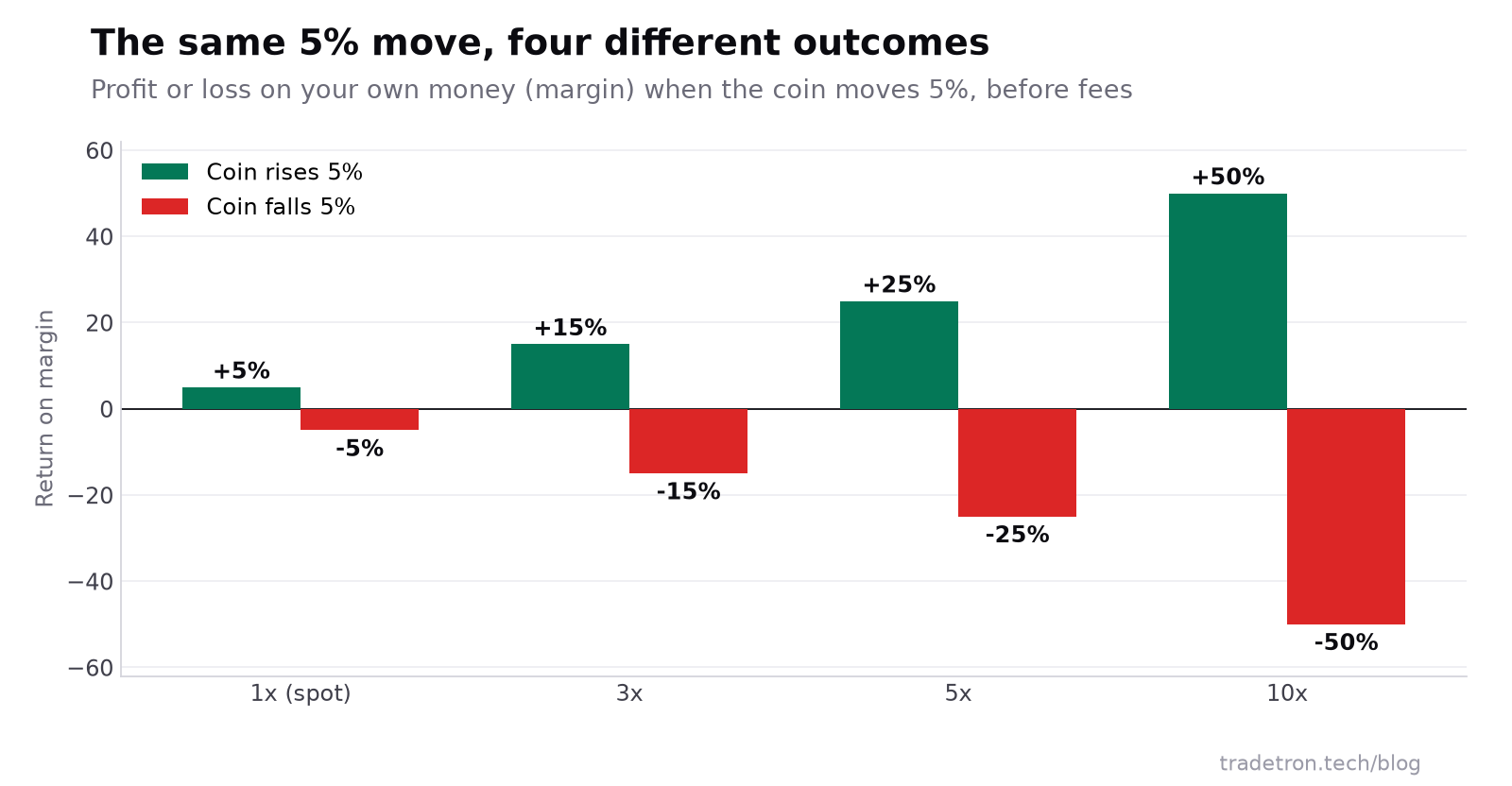 How leverage multiplies a 5% move into returns on your margin
4. Crypto options
A call option gives the right to buy at a set price; a put gives the right to sell. Some exchanges list Bitcoin and Ethereum options with daily, weekly and monthly expiries.
- Buying options: your maximum loss is the premium you paid.
- Selling options: you collect premium, but losses can be large if the price moves sharply.
- Best for traders who already understand options from equity or index trading.
5. Arbitrage trading
Arbitrage tries to profit from the same coin trading at different prices on two exchanges: buy where it's cheaper, sell where it's dearer, at the same moment.
- It sounds low-risk but rarely is in practice. Fees, withdrawal times and slippage often wipe out the gap.
- Speed decides it. Visible gaps are usually closed by faster, professional traders within seconds.
- You need funds on several exchanges at once.
6. Day trading and scalping
Day traders open and close positions within the same day; scalpers take many very short trades for small moves.
- Requires strong technical analysis, focus and discipline.
- Costs matter. With dozens of trades a day, fees can exceed the profits.
- Crypto never closes, so "end of day" is a rule you set yourself.
7. Algorithmic (algo) crypto trading
Algo trading uses fixed rules that a computer executes automatically. It can run any of the styles above: a spot or futures trend strategy, a grid, a scalper, an options strategy.
- Removes emotional decisions and missed exits.
- Runs 24/7, which suits a market that never closes.
- Can be backtested on past data before real money is used.
- Still carries risk: an algorithm follows bad rules as faithfully as good ones.
For more on which rule sets fit which market, see the best algorithm for crypto trading.
Which crypto trading type suits you?
- New to crypto? Start with small spot positions. Learn how prices move before adding leverage.
- Want to hedge or go short? Learn futures and perpetuals with low leverage and a fixed stop-loss.
- Comfortable with options in stocks or indices? Crypto options work the same way, but expect bigger moves.
- Can't watch the market all day? Put your rules into an algorithm so entries and exits happen on time.
- Thinking of arbitrage or scalping? Calculate your costs per trade first. If costs are close to the expected gain, skip it.
Frequently asked questions
What are the main types of crypto trading?
Spot trading, margin trading, futures and perpetuals, options, arbitrage, day trading and scalping, and algorithmic trading. They differ in ownership of the coin, use of leverage, holding period and risk.
Which crypto trading type is best for beginners?
Spot trading, because there is no leverage and the most you can lose is what you invested. Start small and learn how volatile crypto is before trying derivatives.
What is the difference between spot and futures trading in crypto?
In spot trading you buy and own the coin. In futures you trade a contract on its price, usually with leverage, and you can profit from falling prices as well as rising ones.
What are the risks of margin trading in crypto?
Leverage multiplies losses as much as gains, you pay interest on borrowed funds, and the exchange can close your position if losses eat into your margin.
Is crypto arbitrage profitable?
Sometimes, but rarely for retail traders. Gaps between exchanges are usually small and short-lived, and fees, transfer times and slippage often cancel them out.
How can I test a crypto trading strategy before investing?
Backtest the rules on historical data, then run them in a test mode on live prices. On Tradetron the test mode is called Live Offline: trades are recorded, but nothing is sent to the exchange.