What Is the Best Trading Strategy for Crypto?

There is no single best trading strategy for crypto. The best one is the strategy whose rules suit what the market is doing and how much risk you can take: trend following or breakouts when a coin is trending, mean reversion or a grid when it moves sideways, and dollar-cost averaging if you are buying for the long term.

Why crypto needs a written strategy
Crypto is not just a more volatile stock market. Three things make it different:
- 24 × 7 crypto trades round the clock, every day of the year
- 168 hours a week the market is open
- 0 closing bells to stop a bad trade running overnight
- It never closes. There is no 3:30 pm square-off. A position you forget about keeps moving while you sleep.
- It is volatile. Large moves in a single day are normal, especially in smaller coins. A stop that suits a large-cap stock is often too tight here.
- It reacts to news and sentiment. Exchange announcements, regulation headlines and big holders moving coins can all shift prices quickly.
Without written rules, each of those becomes a decision you make under pressure. A strategy decides in advance: when to enter, when to exit, how much to risk. That is what separates trading from guessing.
The 7 most common crypto trading strategies
1. Trend following
Idea: buy when a coin is trending up (or sell short when it is trending down) and stay in until the trend breaks.
How the rules look: a fast moving average crossing above a slow one (for example the 20 EMA crossing the 50 EMA), or price closing above SuperTrend. The exit is the opposite signal or a trailing stop.
Fits: strong bull or bear phases. Struggles: choppy, sideways markets, where crossovers flip back and forth and each flip costs a small loss.
2. Breakout trading
Idea: enter when price breaks out of a range: above resistance, or below support.
How the rules look: "price closes above the highest high of the last 20 candles". Many traders also want volume above its recent average, to filter out weak breakouts. The stop goes just back inside the range.
Fits: coins coiling in a tight range before news or a listing. Struggles: false breakouts, where price pokes through the level and falls straight back.
3. Mean reversion
Idea: prices that stretch far from their average tend to come back towards it. Buy when a coin is unusually oversold, sell when it is unusually overbought.
How the rules look: price below the lower Bollinger Band, or RSI under 30, as the entry; price back at the middle band as the exit. Read more in our Bollinger Bands strategy guide.
Fits: sideways, range-bound markets. Struggles: strong trends, where "oversold" keeps getting more oversold. That is why mean reversion needs a hard stop.
4. Scalping
Idea: take many small profits from short price moves, on 1-minute to 5-minute charts.
How the rules look: a quick momentum or pullback signal, a small target and an equally small stop, often with a time limit on each trade.
Fits: very liquid pairs, and traders who can automate. Struggles: costs. When the target is small, fees and slippage eat a large share of every win:
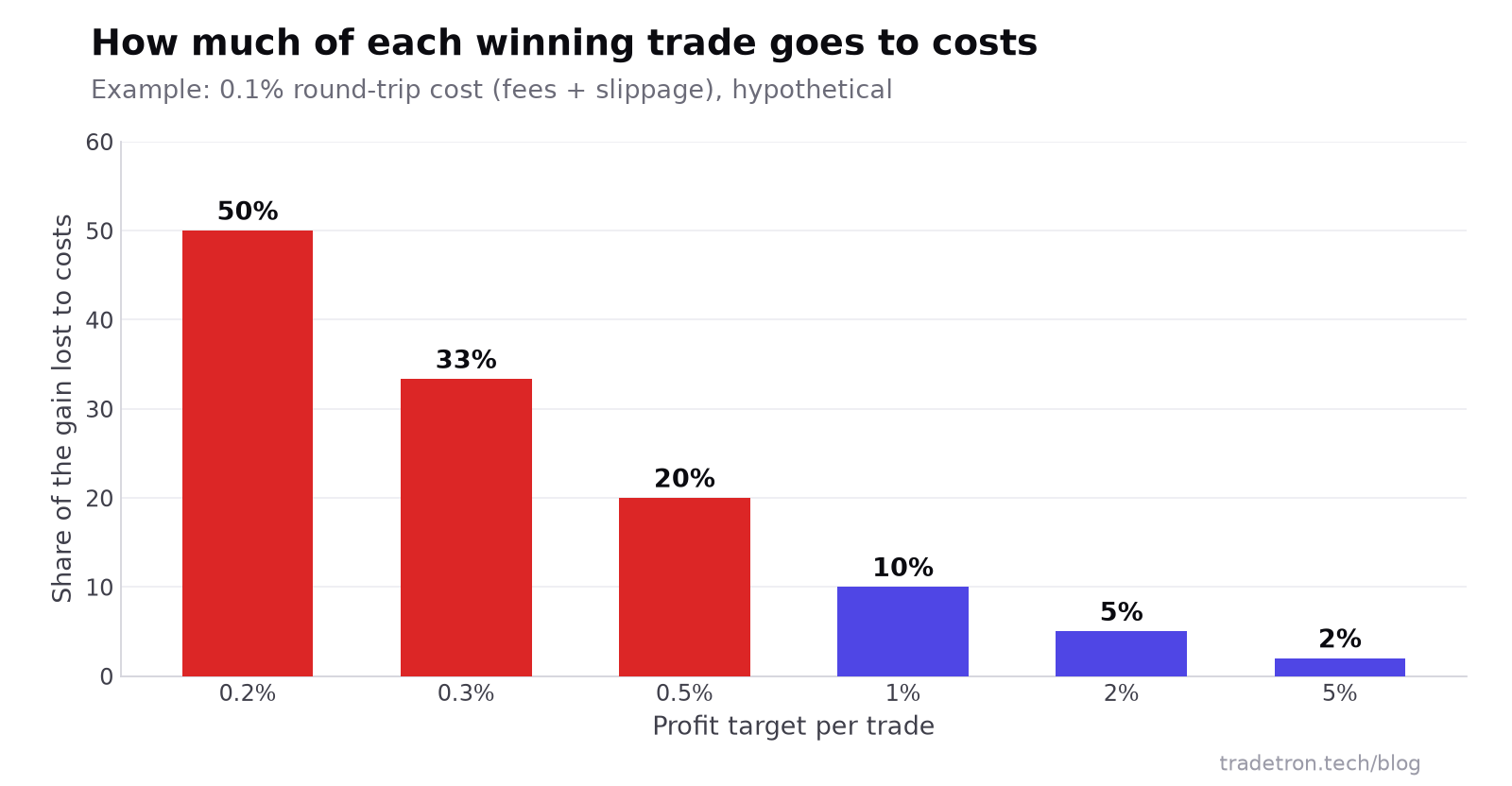 With small targets, costs take a large share of each win
At an example round-trip cost of 0.1%, a 0.2% scalp gives half its gain away. Before you scalp, find out what your exchange actually charges. Our scalping guide covers the mechanics in more detail.
5. Dollar-cost averaging (DCA)
Idea: invest a fixed amount at regular intervals, whatever the price.
How it works: because the amount is fixed, you buy more units when the price is low and fewer when it is high. Your average cost ends up below the simple average of the prices you bought at.
Fits: long-term buyers who don't want to time the market. Struggles: it does not protect you if the coin keeps falling for years. DCA spreads out your entry; it does not make a bad asset a good one.
6. Grid trading
Idea: place buy orders at fixed steps below a central price and sell orders at fixed steps above it, so the strategy buys dips and sells rallies inside a range.
Example: central price ₹100, grid step ₹2. Buy at ₹98, ₹96, ₹94; sell at ₹102, ₹104, ₹106. Each buy is paired with a sell one step higher.
Fits: coins swinging inside a range. Struggles: a breakdown below the grid leaves you holding every buy at a loss. Every grid needs a level at which it stops and exits.
7. Arbitrage
Idea: buy a coin where it is cheaper and sell it where it is dearer, at the same time, to capture the price difference.
Reality check: obvious price gaps between large exchanges close within seconds, and fees, transfer times and withdrawal limits can wipe out the spread. Arbitrage is mostly a game of speed and infrastructure, not a beginner strategy.
Which crypto strategy should you choose?
| Strategy | Market it suits | Risk | Skill needed | Main danger |
|---|---|---|---|---|
| Trend following | Trending | Medium | Intermediate | Whipsaws in sideways markets |
| Breakout | Range about to break | Medium | Intermediate | False breakouts |
| Mean reversion | Sideways | Medium | Intermediate | Catching a falling coin |
| Scalping | Liquid, active | High | Advanced | Costs and slippage |
| DCA | Any, long term | Lower | Beginner | Holding an asset in long decline |
| Grid | Sideways | Medium | Intermediate | Price leaving the grid |
| Arbitrage | Any | Medium | Advanced | Fees, delays, speed |
A practical way to choose:
- Decide your time frame. Minutes (scalping), days to weeks (trend, breakout, mean reversion), or months and years (DCA).
- Look at the market you're trading. Is the coin trending, or swinging inside a range? Pick the strategy built for that.
- Set your risk per trade. Decide the most you will lose on one trade, as a share of your capital, before anything else.
- Write the rules down completely. Entry, exit, stop-loss, position size, and what happens if the market gaps.
- Test before you trade. Run the rules on past data, then live without real money, then with a small amount.
For a deeper look at the rule-writing step, read why entry and exit rules matter in crypto. If you want to compare the algorithm types themselves, see what is the best algorithm for crypto trading.
Risk rules that apply to every crypto strategy
Whatever strategy you pick, these rules matter more than the entry signal:
- Size positions from the stop. If your stop is 5% away and you are willing to lose ₹1,000 on the trade, your position is ₹20,000. A wider stop means a smaller position.
- Use volatility-based stops. A fixed 2% stop that suits a stock is often hit by normal crypto noise. A stop at a multiple of ATR (average true range) adapts to each coin.
- Be careful with leverage. Leverage on crypto derivatives multiplies losses as fast as gains, and a liquidation closes your position for you.
- Cap total exposure. Many coins move together. Five "different" trades can behave like one big one.
Why automation suits crypto
A market that never closes is hard to trade by hand. You cannot watch a chart at 3 am, and a rule you can't watch is a rule you can't follow. Automation helps in three ways:
- Consistency. The strategy does exactly what the rules say, every time, without second thoughts after a losing streak.
- Coverage. It checks your conditions around the clock, including nights and weekends.
- Risk control. Stops and targets are part of the strategy, so they fire even when you're away.
Automation does not make a weak strategy profitable. It makes a tested strategy run the way you tested it.
New to automating crypto? Start with crypto algo trading without coding and how crypto trading works.
Frequently asked questions
What is the best trading strategy for crypto beginners?
Dollar-cost averaging is the simplest, because it needs no timing: you invest a fixed amount on a schedule. If you want to trade actively, trend following is easier to understand and test than scalping or arbitrage. Whatever you choose, start small and use a stop-loss.
What is the safest crypto trading strategy?
No crypto strategy is safe, because the asset itself is volatile. DCA has the lowest timing risk, since you never put all your money in at one price. For active trading, the safest habit is a fixed risk per trade and a stop-loss set before you enter.
Is scalping profitable in crypto?
It can be for some traders, but costs decide it. With small profit targets, fees and slippage take a large share of each win, so scalping needs low costs, very liquid pairs and fast, automated execution. Work out your costs before you start.
What is the best crypto strategy in a bear market?
In a falling market, trend following on the short side (where your exchange allows it), or staying out entirely, are common choices. Mean reversion and grids can work if the coin is moving sideways after the fall, but they need a firm exit if the decline resumes.
Can I automate a crypto trading strategy without coding?
Yes. On a no-code platform like Tradetron you build the entry, exit and stop-loss as conditions, backtest them, and then run the strategy on a connected exchange such as Delta Exchange India.
How do I backtest a crypto strategy?
Write the strategy as exact rules, run it on historical price data, and check the number of trades, the drawdown and how results change across different periods. Then run it on live prices without real money before you trade it.