Algo Trading Options: How US Traders Can Automate Their Trades
Algo trading options means writing your options trades as fixed rules (when to enter, which strikes, how much, when to exit) and letting software place and manage the orders through your broker. For US traders that usually means SPX, SPY or QQQ spreads, iron condors and straddles, run by a platform that watches the market all session and never skips a stop.

What algo trading options actually involves
In manual trading, you look at the chart, open the option chain, pick strikes, place each leg, then watch the position until you decide to close it. An algorithm does the same steps, but every decision is written down in advance:
| Decision | Manual trader | Options algo |
|---|---|---|
| When to enter | When it "looks right" | A condition: a time, a price level, an indicator value |
| Which strikes | Picked from the chain | A rule: ATM, X points from spot, or a premium target |
| How much | Gut feel | A formula: fixed contracts or a % of capital |
| When to exit | Often negotiated with | Stop-loss, target, trailing stop or a time exit |
| Adjustments | Ad hoc | Pre-defined: roll, shift strikes or cut size when a level is hit |
The value is consistency. A rule that says "close both sides if the loss reaches 2× the credit" gets followed on the day you would have hoped for a bounce.
Why options are a good fit for automation
- Multi-leg trades. An iron condor has four legs. Placing them one at a time by hand in a moving market costs you on fills; an algo sends them together and manages them as one position.
- Time matters. Options lose value as expiry approaches, and many strategies depend on exiting at a set time. Software doesn't forget the clock.
- Speed in fast markets. When the underlying moves sharply around a data release, a stop that triggers immediately is worth more than one that triggers after you notice.
- Discipline. Most damage in options trading comes from moving stops, adding to losers and oversized positions. Rules written in advance remove those choices.
- Testability. A precisely written rule can be backtested. A feeling can't.
SPX vs SPY options: know what you are automating
US traders often choose between options on the S&P 500 index (SPX) and options on the SPY ETF. The contract details change how an algorithm should handle them.
| SPX options | SPY options | |
|---|---|---|
| Underlying | S&P 500 index | SPY ETF shares |
| Settlement | Cash | Physical: 100 shares per contract |
| Exercise style | European (only at expiry) | American (any day), so early assignment is possible |
| Size | About 10× SPY per contract | Smaller, easier to size small accounts |
| Expiries | Every weekday | Every weekday |
| US tax (taxable accounts) | Section 1256: 60% long-term, 40% short-term | Normal short- or long-term rules |
For short premium strategies, SPX's cash settlement and European exercise remove the risk of waking up with an unexpected share position. SPY suits smaller accounts and traders who want to hold or deliver shares.
Options strategies traders commonly automate
- Credit spreads: sell one option and buy a further one for protection. Defined risk, profits if the underlying stays on your side of the short strike.
- Iron condors: a put credit spread plus a call credit spread. Profits if the underlying stays in a range.
- Straddles and strangles: buy them for a big move, or sell them (with hedges) to collect time decay.
- Covered calls: own 100 shares and sell a call against them.
- Directional debit spreads: buy a call or put spread on a breakout or trend signal, with a fixed target and time exit.
- 0DTE structures: trades opened and closed on expiration day itself, where automation's speed and time exits matter most. Read our guide to running a 0DTE options strategy as a system.
Example: an SPX iron condor, by the numbers
The figures below are an example, not market prices. With SPX at 6,000, you sell the 5,900 put and the 6,100 call, and buy the 5,850 put and 6,150 call as protection, for a net credit of $15.
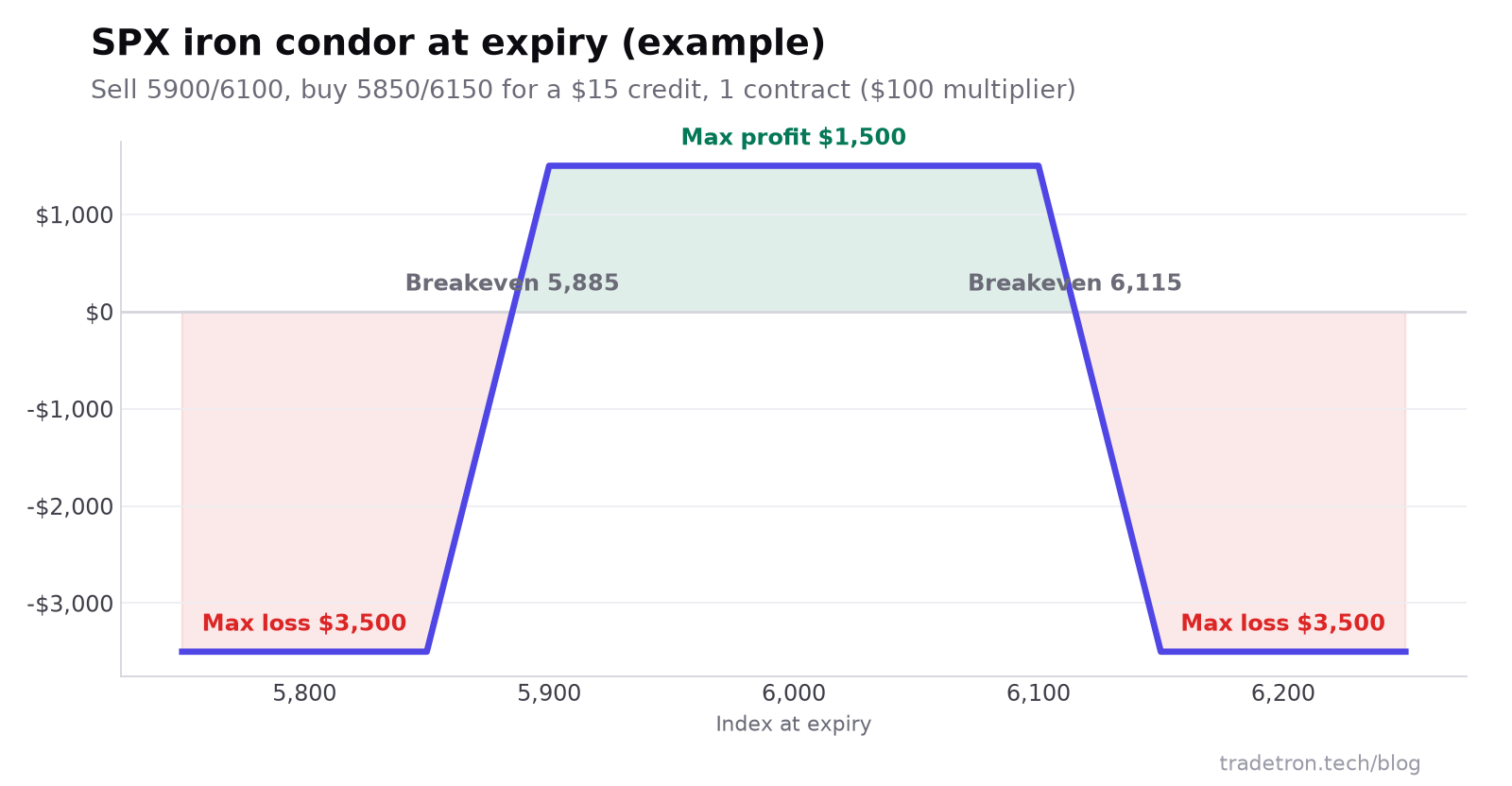 Iron condor payoff at expiry (example figures)
- $1,500 maximum profit: $15 credit × $100 multiplier
- $3,500 maximum loss: ($50 spread width − $15 credit) × 100
- 5,885 / 6,115 breakevens: short strikes ∓ the credit
The payoff shows why rules matter. Most days the position sits in the green zone. The days that matter are the ones where the index runs through a short strike, and an algorithm's job is to apply your exit before a manageable loss becomes the maximum one.
How to build an options algo, step by step
- Pick the objective. Income from time decay, a directional view, or a volatility trade. Each needs different rules.
- Write the rules in plain English. For example: "At a fixed time after the open, sell a 50-point-wide SPX iron condor with short strikes about 100 points from spot. Exit both sides if the combined loss reaches 2× the credit, take profit at 50% of the credit, and close everything 30 minutes before the bell."
- Choose the broker. It must support options trading through an API and grant you the right options approval level for spreads.
- Encode the rules on your platform: entry conditions, legs with strike selection, per-leg stops and targets, a strategy-level loss limit and a time exit.
- Backtest across calm and volatile periods. Look at the worst day and the worst month, not just the average.
- Run it in a simulated mode in live market conditions and compare fills and behaviour with the backtest.
- Go live small, and scale only after the live results look like the tests over a meaningful number of trades.
Risks to plan for
- Gap and event risk. Index options can move sharply on economic data or overnight news. Defined-risk structures cap the damage; naked short options don't.
- Liquidity. SPX, SPY and QQQ options are very liquid. Options on smaller stocks can have wide spreads that eat most of a strategy's edge.
- Early assignment on American-style options such as SPY, especially on short calls before an ex-dividend date.
- Overfitting. A rule tuned to look perfect on past data often fails live. Keep rules simple and test on periods you didn't tune on.
- Execution differences. Backtests assume fills you may not get. Compare live and test results and adjust the assumptions.
New to the platform side? Read our complete guide to Tradetron as an algo trading platform for the USA, or see how to connect Tastytrade.
Frequently asked questions
Is algo trading options legal in the USA?
Yes. Retail traders in the US can run automated options strategies through brokers that offer API trading. You must still meet your broker's options approval requirements and follow its rules and the usual exchange rules.
Do I need to code to automate options trading?
No. No-code platforms let you build entry, exit and strike-selection rules from menus and conditions. Coding helps only if you want logic the platform can't express.
Which options strategies are easiest to automate?
Defined-risk, rule-friendly structures: credit spreads, iron condors, covered calls and debit spreads with fixed targets and time exits. They have clear entry and exit logic and a known maximum loss.
Should I trade SPX or SPY options with an algorithm?
SPX options are cash-settled and can't be assigned early, which simplifies short premium strategies, and US taxpayers get 60/40 tax treatment on them. SPY options are about one-tenth the size, which makes small accounts easier to size, but they settle in shares and can be assigned early.
How much money do I need to start algo trading options?
It depends on your broker's minimums, the margin your strategy needs, and the size of the contracts. A defined-risk spread ties up roughly its maximum loss, so a single SPX iron condor in the example above needs about $3,500 of buying power.
Can I test an options algo without risking money?
Yes. Backtest it on historical data first, then run it in a simulated mode during live markets. On Tradetron that mode is Live Offline: the strategy runs and records every trade, but nothing is sent to the exchange.