The Best 0DTE Options Strategy Is a System You Can Actually Run

The best 0DTE options strategy is not a secret setup. It is a defined-risk structure, usually a credit spread, iron condor or debit spread on SPX, run by written rules: a fixed entry window, a stop, a profit target, a hard time exit and a daily loss limit. The edge comes from following those rules every day, which is exactly where most traders fail.

What 0DTE options are
0DTE stands for "zero days to expiration": an option traded on the day it expires. In the US the most traded 0DTE contracts are on the S&P 500 index (SPX), which now has expiries every weekday. SPY, QQQ and the mini-SPX (XSP) also have daily expiries.
- 5 SPX expiries a week, one every trading day
- 6.5 hours in the regular session for the whole trade to play out
- $100 per point on one SPX contract
Why they attract traders: the result is known by the close, there is no overnight risk, and option sellers collect premium when time decay is at its fastest. Why they hurt traders: the same speed works against you. Near expiry an option's delta can swing from 0.2 to 0.8 on a modest move, and a spread that looked safe at 2 PM can be at its maximum loss by 3:30.
Why there is no single "best" 0DTE strategy
Screenshots of "95% win rate" 0DTE strategies leave out the other half of the math. How often you win only matters next to how much you win and lose.
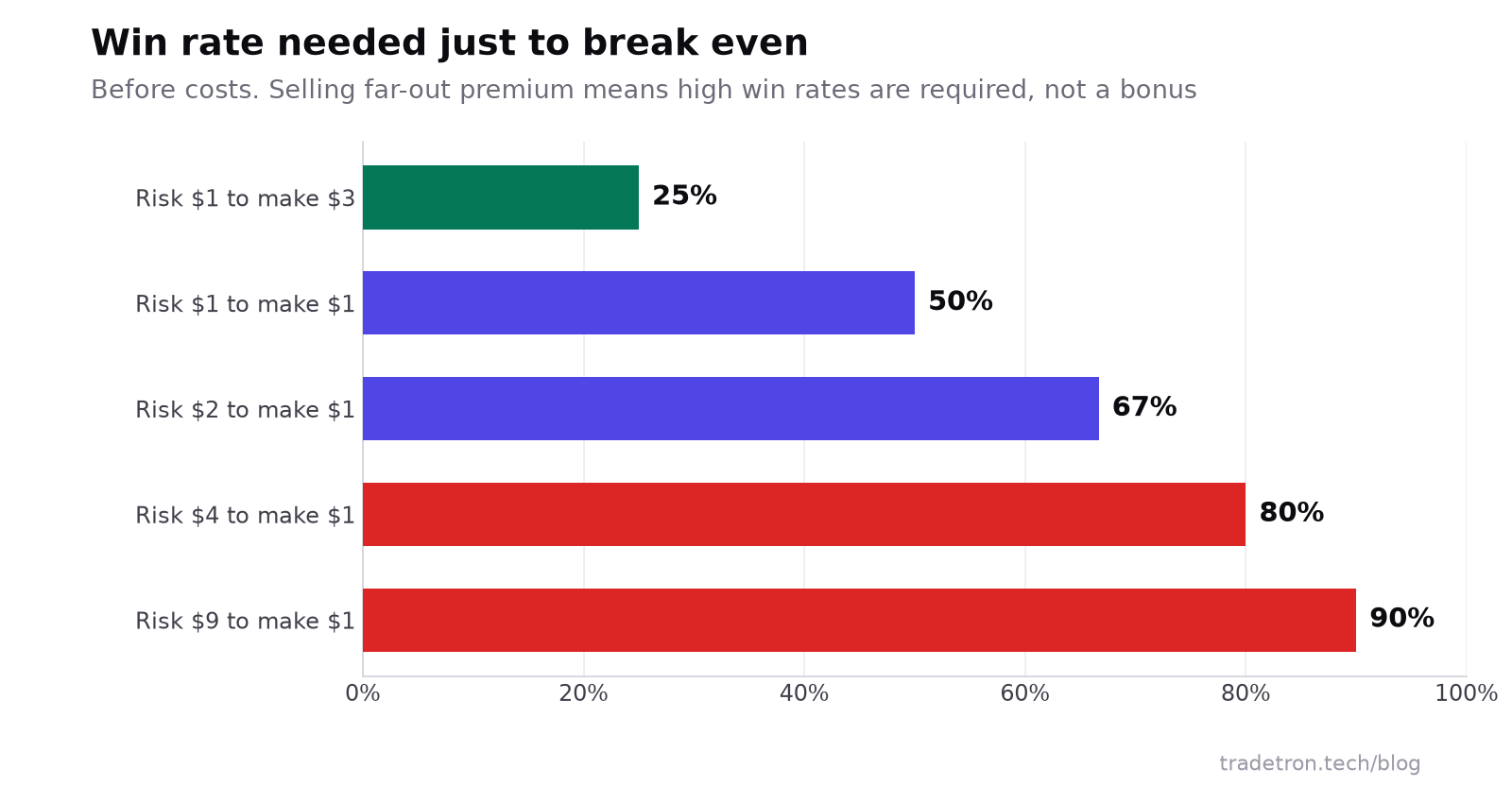 Break-even win rate at different risk-to-reward ratios, before costs
So "best" depends on three things that differ for every trader:
- Account size. One SPX spread can risk several hundred to a few thousand dollars. A small account may need XSP or SPY to size sensibly.
- Schedule. Someone at a desk all day can trade differently from someone with a day job.
- Tolerance for losing streaks. Short premium strategies produce many small wins and occasional large losses; long premium strategies the reverse. Choose the pattern you can sit through.
The common 0DTE structures, compared
| Structure | View | Max loss | Typical pattern | Fits |
|---|---|---|---|---|
| Put or call credit spread | Index stays above or below a level | Spread width minus credit | Frequent small wins, rare larger losses | Rules-based sellers |
| Iron condor | Index stays in a range | One side's width minus total credit | Same as above, both sides | Calm, range-bound days |
| Iron butterfly | Index pins near one price | Wing width minus credit | Larger credit, lower win rate | Traders who manage actively |
| Debit spread | Directional move | The debit paid | Fewer, larger wins | Trend or breakout traders |
| Long straddle or strangle | Big move either way | The premium paid | Many small losses, occasional big win | Event days, with strict time exits |
Example: a 0DTE put credit spread
The figures are an example, not real quotes. With SPX at 6,000 in the late morning, you sell the 5,970 put and buy the 5,960 put for a $2.00 credit.
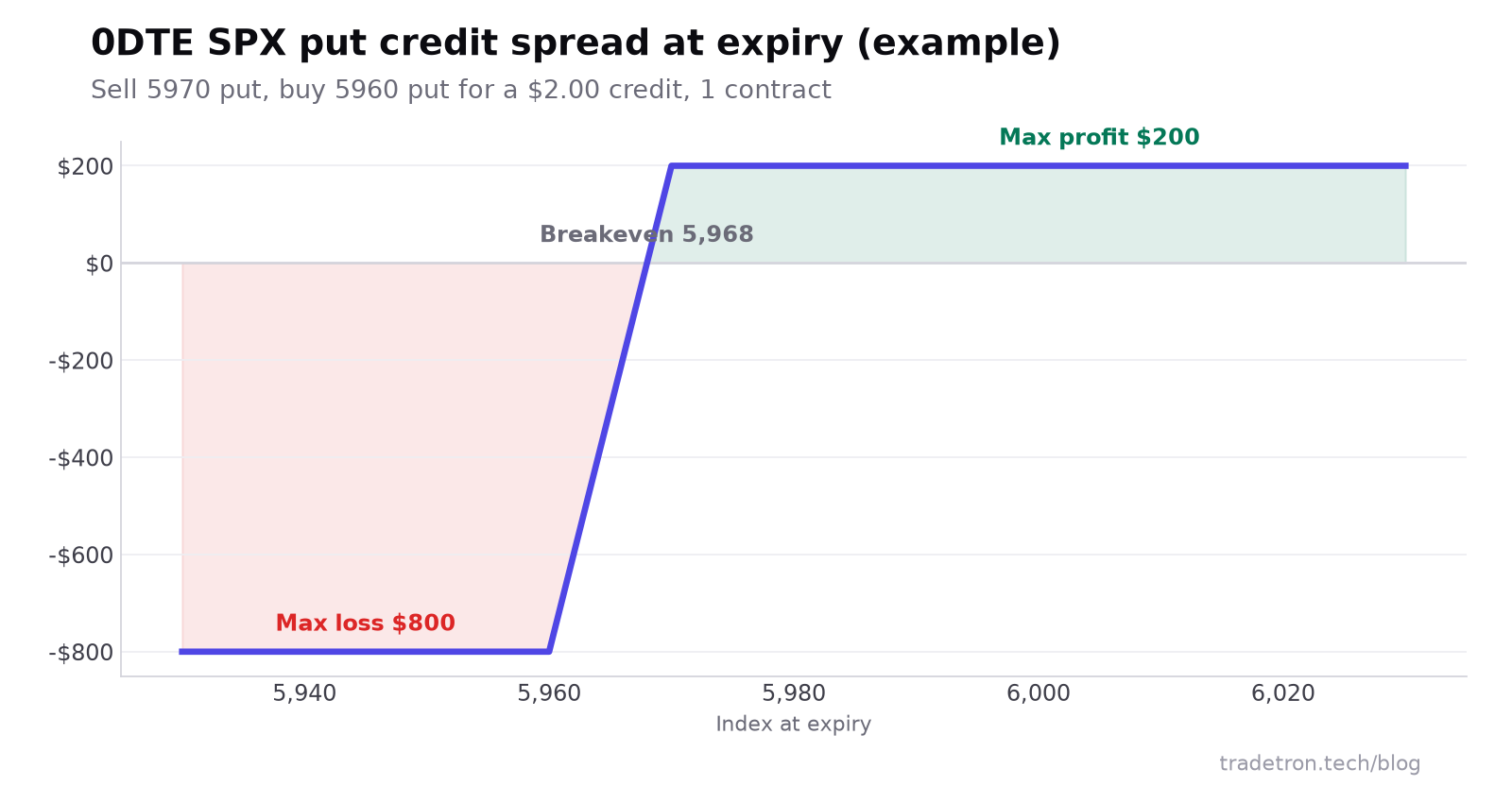 Put credit spread payoff at expiry (example figures)
You make $200 if SPX closes above 5,970 and lose up to $800 if it closes below 5,960. That is risking $4 to make $1, so the strategy needs to win more than 80% of the time before costs. Your stop-loss rule is what keeps the average loss well below $800, and it is the part of the strategy most worth testing.
The four rules every 0DTE system needs
Whatever the structure, a 0DTE strategy that lasts has the same skeleton.
- Define risk first. Maximum loss per trade and per day, in dollars, decided before the first trade.
- Make the entry specific. A time window plus a condition you can measure: price vs the open, a range break, or a volatility filter. "Looks oversold" is not a rule.
- Exit by rule. Profit target, stop-loss and a hard time exit. On 0DTE the time exit matters most, because the last hour is when gamma does the most damage.
- Size for the losing streak. Assume several maximum-loss days in a row and check the account survives them comfortably.
Three trader profiles, three different "best" strategies
"I want many small wins." Credit spreads or iron condors entered after the open, with a fixed stop and a hard time exit. The risk is the occasional large loss, so the stop and the daily limit are the whole strategy.
"I want fewer trades with bigger payoffs." Debit spreads triggered by a breakout above the morning range, with a target at a set multiple of the debit and a time exit. Expect lower win rates and longer flat spells.
"I have a day job." A single trade in a fixed window, defined risk, and every exit automated. Without automation this profile shouldn't trade 0DTE at all, because a position you can't watch in the last hour is the one that hurts.
Test before you trust it
- Backtest across calm and volatile months. Look at the worst day, worst month and longest losing streak, not just the average.
- Run it simulated in live markets for a few weeks. Check that entries fire when you expect and fills look like the backtest assumed.
- Go live with one contract. Compare live results with the test. If they diverge, find out why before adding size. Our guide on why backtests don't match live trading lists the usual causes.
- Review monthly, and change rules only on evidence, never after a single bad day.
For the build itself, follow how to automate a 0DTE SPX strategy without coding. To understand why 0DTE prices move so violently near the close, read our SPX gamma strategy guide.
Frequently asked questions
What is the best 0DTE options strategy?
There is no single best one. Most durable 0DTE systems use a defined-risk structure such as a credit spread, iron condor or debit spread, with a fixed entry window, a stop, a target, a hard time exit and a daily loss limit. The right structure depends on your account size, schedule and tolerance for losing streaks.
Are 0DTE options good for beginners?
Usually not as a first step. Prices move very fast on expiry day and mistakes are expensive. If you do start, use defined-risk spreads, trade one contract, and test the rules in a simulated mode first.
Which is better for 0DTE: SPX or SPY?
SPX options are cash-settled and European-style, so there is no assignment into shares, and US taxpayers get 60/40 tax treatment. SPY options are about one-tenth the size, which suits smaller accounts, but they settle in shares. XSP, the mini-SPX, is a cash-settled middle ground.
What time of day is best to trade 0DTE options?
Many systematic traders avoid the first 15–30 minutes, when spreads are wider and direction is unsettled, and close positions before the last half hour, when gamma is highest. The right window for your rules is something to test, not assume.
How much money do I need to trade 0DTE options?
Enough that one spread's maximum loss is a small slice of your account, commonly 1–2%. A 10-point SPX credit spread can risk up to $1,000 per contract, so smaller accounts often use XSP or SPY spreads instead.
Can 0DTE trading be automated?
Yes. Entry windows, strike selection, stops, targets, time exits and daily loss limits are all rules a platform can apply. On Tradetron you can build them without code, backtest them, and run them Live Offline before trading real money.