Basket Trading Strategies for Your Portfolio: A Practical Guide
Basket trading means buying or selling a group of stocks as one unit, instead of placing each order separately. A basket strategy decides which stocks go in, how much of each you hold, and when you rebalance. Done well, it spreads your risk across several companies and keeps your portfolio following a plan rather than your mood.

Basket trading, basket orders and baskets of stocks
These terms get mixed up, so here is what each means:
| Term | What it is | Example |
|---|---|---|
| Basket order | One instruction that places several orders at once | Buy 10 stocks with a single click |
| Basket of stocks | The group itself, with a weight for each stock | Five IT stocks at 20% each |
| Basket trading strategy | The rules for building, sizing and rebalancing the basket | Equal-weight top 10 NIFTY stocks, rebalanced quarterly |
A basket order is a convenience at your broker. A basket strategy is a plan you follow for months or years. Read what a basket order is for the order side; this guide is about the strategy.
Six basket trading strategies
- Index track a broad market cheaply and simply
- Theme concentrate on one sector or trend
- Quality steady businesses and dividend payers
- Momentum stocks already moving up, reviewed often
1. Index-tracking basket
Hold the largest stocks of an index, such as the top 10 or 20 NIFTY 50 constituents, either equal-weighted or close to their index weights. It gives broad market exposure with stocks you can see and adjust. If you only want to match the index, an index fund or ETF is simpler; a basket makes sense when you want to drop or tilt certain names.
2. Sector or thematic basket
Group stocks from one sector or theme, such as private banks, IT services, or companies tied to power and infrastructure. This is a bet on that theme, not diversification: when the sector falls, the whole basket falls with it.
3. Quality and dividend basket
Pick companies with steady earnings, low debt and a record of paying dividends. Usually less exciting, often steadier in falling markets. Useful as the core of a long-term portfolio.
4. Momentum basket
Hold stocks that have risen the most over a set period, such as the last six months, and refresh the list regularly. Momentum baskets need strict rules and frequent reviews: when momentum turns, it can turn fast.
5. Balanced basket
Mix a growth basket with a quality or dividend basket, for example 60:40. The steadier half cushions the more volatile half.
6. Custom basket
Your own picks and weights, built around your goals and research. The rules still matter: write down why each stock is in and what would make you remove it.
How to weight a basket
| Method | How it works | Good for |
|---|---|---|
| Equal weight | Same amount in each stock | Simple baskets; avoids one stock dominating |
| Conviction weight | More in the stocks you're most sure about | Custom baskets with clear reasoning |
| Index-style weight | Bigger companies get bigger weights | Tracking an index closely |
| Risk-based weight | Less in volatile stocks, more in steady ones | Keeping each stock's swings similar |
Rebalancing: why baskets drift
Once you buy, prices move and your weights move with them. Winners grow into a bigger share of the basket; losers shrink. After a while, your "equal-weight" basket is really a bet on whatever went up most.
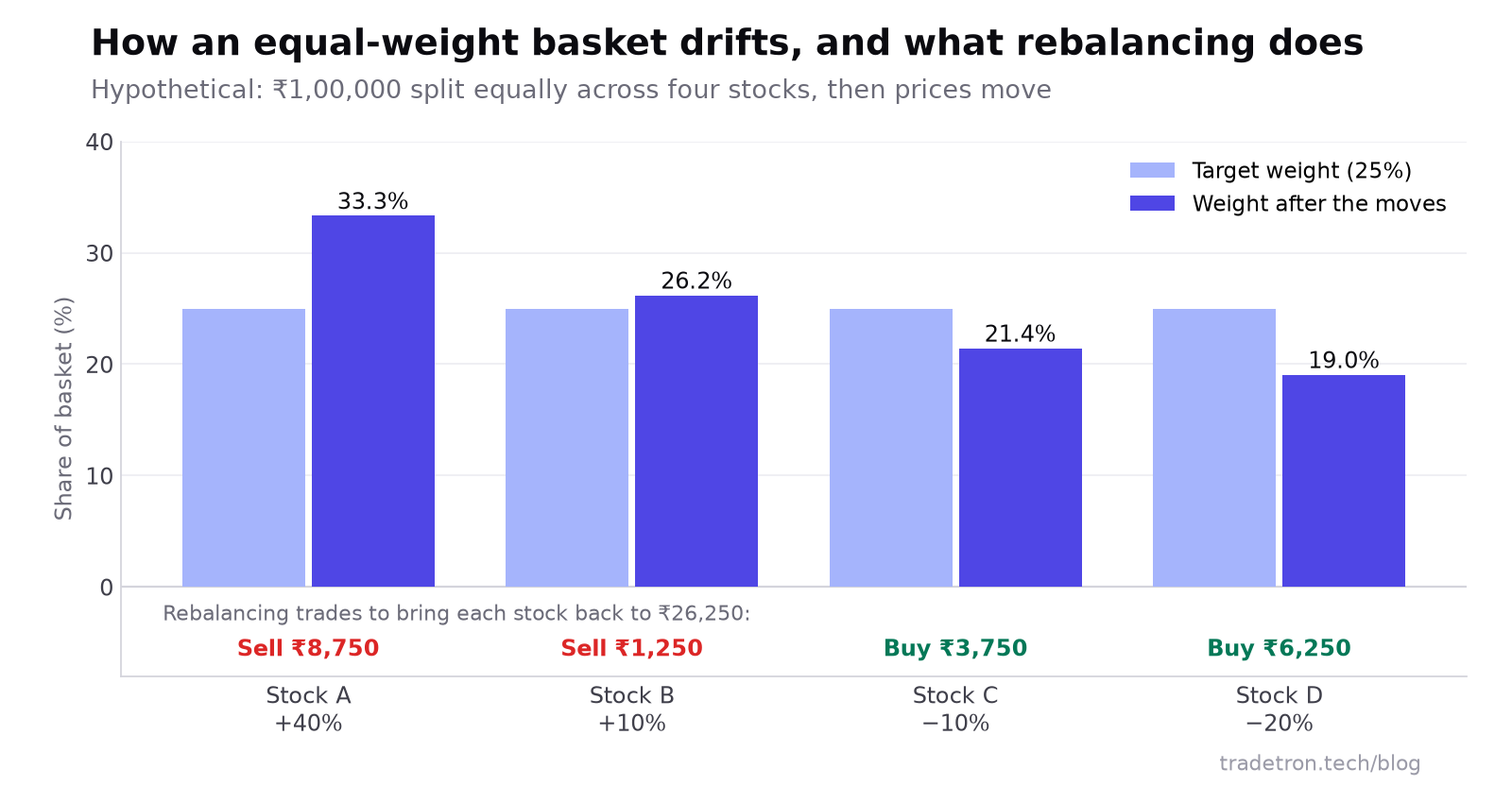 How weights drift, and the trades that restore them (hypothetical prices)
Two common ways to decide when to rebalance:
- On a calendar: every quarter, half-year or year. Simple and predictable.
- On a threshold: whenever a stock's weight moves more than a set amount from its target, such as 5 percentage points.
Each rebalance has a cost: brokerage, STT, and possibly capital gains tax on the stocks you sell. Rebalancing too often eats into returns, so pick a rhythm and stick to it.
Risks people miss with baskets
- Correlation. Ten stocks from the same sector behave like one big position.
- Concentration through drift. Without rebalancing, one winner can become half the basket.
- Costs. A basket order doesn't reduce charges: each stock is still a separate trade.
- Liquidity. Thinly traded stocks can fill at poor prices, especially when you buy the whole basket at once.
- Overfitting. A basket picked because it did well last year isn't a strategy. Write the selection rule first, then check it on past data.
How to build and run a basket on Tradetron
Tradetron offers two ways to run a basket, depending on what you want it to do.
| You want to… | Use | How it works |
|---|---|---|
| Hold a portfolio and rebalance it | Stockbag | A basket of stocks with weights, deployed and managed as one portfolio |
| Trade each stock on its own signal | Lists in the strategy builder | One entry and exit rule, checked separately for every stock in the list |
Build a Stockbag
- Go to Create → Stockbag on the Tradetron dashboard.
- Name it, add a tag and a description, such as "Equal-weight private banks".
- Add your stocks. By default each gets an equal weight.
- Adjust the weights if you want. You can lock a stock's weight, and the rest rebalance around it.
- Check the minimum investment the Stockbag needs, which is calculated as you build.
- Deploy it, first as a test, then live with your connected broker.
After deployment you can add funds or withdraw, and the Stockbag keeps the proportions. You can also share a Stockbag or offer it to others as a subscription. Read the full Stockbag guide.
If you'd rather trade each stock on a signal, such as a breakout or an indicator, see Lists in Tradetron.
Frequently asked questions
What is basket trading?
Basket trading is buying or selling a group of stocks as one unit. A basket trading strategy adds rules for which stocks are in the basket, how much of each to hold, and when to rebalance.
Is basket trading good for beginners?
It can be, because it spreads money across several stocks instead of one. Start with a simple, broad basket and equal weights, and rebalance on a fixed schedule. Avoid narrow thematic or small-cap baskets until you understand the risk.
Does a basket order reduce brokerage?
No. A basket order places several orders at once, but each stock is still a separate trade with its own brokerage, STT and other charges. The saving is in time and consistency, not costs.
How often should I rebalance a basket?
Common choices are quarterly, half-yearly or yearly, or whenever a stock drifts more than a set amount from its target weight. More frequent rebalancing means more trades, costs and possibly tax.
What is the difference between a basket and a mutual fund?
In a basket you hold the stocks directly in your own demat account and choose them yourself. A mutual fund pools money from many investors and a fund manager picks the stocks.
Can I automate basket trading?
Yes. On Tradetron, a Stockbag holds and manages a weighted basket of stocks, and a List lets one rule-based strategy trade each stock in a group on its own signals.
What are the risks of basket trading?
The basket still carries market risk. Stocks from the same sector move together, winners can come to dominate without rebalancing, and every trade has costs. A basket reduces the damage from one bad stock, not from a falling market.